To inspire, educate, and help people of all ages with both lack of motivation and mental health awareness. If you want to achieve better success in life, build strong relationships, become a good leader, and be an idol to your parents, then we will drive you to long-lasting development.
Email Us: info@timesinspiration.com
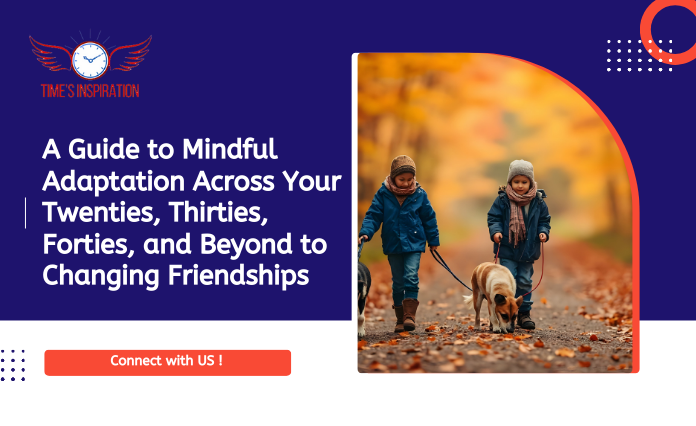
A Guide to Mindful Adaptation Across Your Twenties, Thirties, Forties, and Beyond to Changing Friendships
January 28, 2026
0
Friendships: A Guide to Mindful Adaptation in Your Twenties and Beyond – Unpleasant developments in life are seldom announced. On a certain day, you find yourself in the
Friendships: A Guide to Mindful Adaptation in Your Twenties and Beyond –
Unpleasant developments in life are seldom announced.
On a certain day, you find yourself in the company of friends—whether they be classmates, coworkers, neighbours, or cousins—who are all laughing, dreaming, and talking nonstop. The calls gradually decrease, messages are ignored, and birthdays are forgotten until much later.
You are not alone if you have ever pondered the reasons behind the transformation of friendships with age. Whether you are starting a new job, starting a family, taking on leadership responsibilities, or just approaching maturity, changing friendships might feel personal, even if they aren’t.
The loss of a buddy can be an unseen emotional weight for many folks. Relationships in a fast-paced, achievement-driven setting typically end not due to arguments but to separation, change, and the inability to communicate.
Understanding why friendships change in adulthood and how to adapt without bitterness, regret, or self-blame is the compassionate and sensitive subject of this essay.
Having friends in your twenties is usually a breeze. You probably run across your “people” on a daily basis, whether they are classmates, coworkers, or neighbours. However, life’s inevitable ups and downs cause people’s priorities to shift, families grow, and professions evolve with time. Texts go unanswered, chats get shorter, and scheduling reunions takes months.
Friendships do not feel the same anymore, and if you have ever wondered why, or felt bad about it, you are not alone. No matter what stage of life we are in, maintaining meaningful relationships with other people is essential to our emotional and psychological well-being. If you want to know why friendships change and how you can consciously adjust without losing your composure or sense of self-worth, this essay is for you.
What Happens to Your Friendships When You Age
Connectivity is hardwired into the human brain. When we have friends, we feel more secure, accepted, and confident in ourselves. Their changes have an effect that goes beyond our wildest expectations.
For the duration of our lives:
More work is required of you
As time goes forward,
Ideals change
The growth of emotional demands
According to psychologists, shared environments and daily routines significantly impact friendships. In our formative years, we are able to take use of closeness to connect with ease; this is especially true in settings like school, college, neighbourhoods, and similar schedules.
Such frameworks decompose as adults.
When we mess up, it does not mean our friendship dies. Because life is dynamic, they evolve.
An adult’s capacity for friendship has been shown by psychologists to be an important indicator of both emotional stability and lifespan. Longevity, health, and happiness are all positively impacted by having friends who have one’s back, according to research out of Harvard and Stanford.
But when you are going through a shift, like changing careers, having a family, or relocating, the joy of friendship tends to fade. Distance or a lack of similar values make it difficult for the brain’s social reward system to establish a relationship, despite its desire for it.
By practicing mindfulness, a sense of equilibrium can be achieved in this situation. Rather than seeing feelings of isolation or disappointment as signs of weakness, it encourages us to observe them without passing judgement and use them as opportunities for constructive criticism.
Why Friendships End and How to Mend Them
Adult relationships can be better understood with the aid of social psychology. Psychologist Laura Carstensen proposed the famous Socioemotional Selectivity Theory, which states that people inevitably pick fewer, more emotionally significant relationships as they age.
Changing careers does not mean emotionally disengaging.
This is the wisdom of the heart.
Instead of viewing friendships as inflexible obligations, practicing mindfulness allows us to see them as dynamic systems. Relationships are meant to shape us for a season, and some are meant to endure decades.
A Quiet Emotional Battle Unspoken By Most people, losing friends is not a big deal.
What does it say about them? They try to make sense of it.
“Why are not they contacting us anymore?”
“Did I stop being significant?”
“Even though everything seems to be going swimmingly, why am I still so lonely?”
Slowly but surely, unprocessed friendship loss might cause:
Feelings of isolation
Uncertainty and worry
Isolation from others
Worry about making new connections
Due to the taboo nature of discussing adult loneliness, many individuals endure it in quiet, fooling themselves into thinking they are unique.
The pain of losing a buddy is genuine, but we hardly discuss it. We go through emotional withdrawal, remorse, and confusion when a close friend disappears or does not “fit” into our life’s rhythm. “Did I mess up?” or “Have I changed too much?” are questions we often ask ourselves.
Personal health, efficiency, and confidence can all take a hit from this latent worry. Assuming we are “not good at maintaining friends,” we can withdraw from others. The fact is that even the most well-adjusted individuals experience this.
Friendships in Your Twenties: Coming of Age, Distancing Yourself, and Identity
Time flies when you are in your twenties:
Investigating one’s identity
Career unpredictability
Exploring the realm of emotions
Because you are changing so fast, your friendships are also changing so fast.
There are friends who progress alongside you. Some people represent the old you that you are trying to shed. Being able to tolerate space without hostility is an important part of mindful adaptation at this level.
Friendships in Your Twenties: Coming of Age, Distancing Yourself, and Identity
No one should go at the same pace or along the same route.
A Look at Friendships in Your Thirties: Duties, Limits, and Priorities
As you enter your 30s, numerous opportunities present themselves:
Energise your career
Family members must be present A purposeful use of time
Understanding, rather than frequent physical contact, is the foundation of friendships that make it through this phase. Frequency is less important than depth. Availability is less important than flexibility.
When individuals realise that maintaining meaningful relationships requires work, not luck, this is often the turning point in their lives.
Deep, Lost, and Rekindled Friendships in Your Fortieth and Later Years
Clarity is often provided by later maturity:
An improved understanding of one’s own experiences with change and loss
A yearning for authentic rapport
Less friends, but richer friendships. Discussions progress. Physical presence is more important than performance.
This is not the decline of society. Relational maturity is what it is.
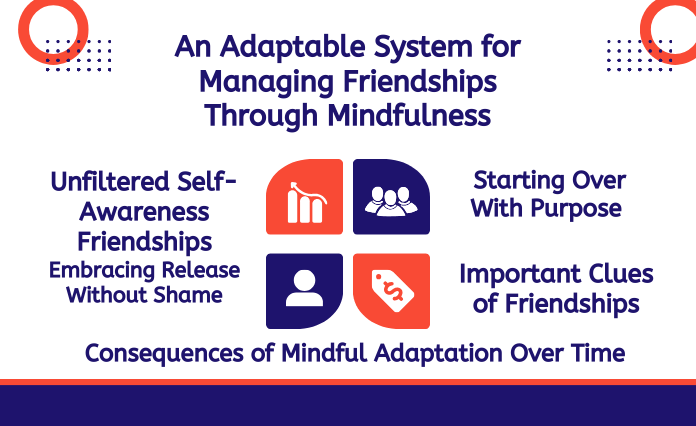
An Adaptable System for Managing Friendships Through Mindfulness
An Adaptable System for Managing Friendships Through Mindfulness
Unfiltered Self-Awareness Friendships
Pay attention to your emotions without labelling them as failure.
Practicing mindfulness can help reduce emotional reactivity and self-blame. Ask yourself, “What is happening in my life at the moment?” rather than “What is wrong with me?”
Embracing Release Without Shame
Certain friendships are more like chapters than novels that never end.
Love and purpose are unaffected by letting go. Feelings of emotional liberation, rather than regret, are the result of being grateful for the benefits of a friendship.
Starting Over With Purpose
Intention nourishes adult friendships.
Opt for relationships that align with your current principles. Reward those who are trustworthy, present, and respectful by investing in fewer individuals.
Important Clues of Friendships
Friendships evolve with age, and that is a good thing.
Having fewer friends does not imply having less value or connection.
Mindful acceptance reduces feelings of isolation, guilt, and self-criticism.
Building meaningful connections fosters a more secure emotional environment
Consequences of Mindful Adaptation Over Time
When you intentionally adapt to new friendships, you cultivate:
Mental steadiness
Feeling less lonely and anxious
Deeper bonds within the family and the workplace
Higher levels of compassion and moral leadership
Peaceful, long-term self-assurance
When people are with you, they feel this inner steadiness.
Overcoming Depression and Finding Inner Peace
At the age of 38, a professional in the middle of his career noticed a decline in his social circle. He felt bewildered and critical of himself as old relationships faded away without a fight. He reached a turning point when he realised that silence was not always a sign of rejection.
He joined a values-based community, practiced acceptance, and re-established connection—carefully, deliberately, and without pressure. He also scheduled one meaningful interaction per week.
The isolation persisted for some time.
Still, it became softer.
An inseparable college clique formerly belonged to 27-year-old Riya. But once she left for another country, she was left to rummage through old photos as her friends’ lives progressed without her. Rather than becoming resentful of being apart, she started sending thoughtful voice notes on a weekly basis, prioritising quality connection over frequent physical contact.
After becoming a father, 39-year-old Arun, a middle manager, felt lonely. Due to his busy work and family life, he barely had time for his social life. However, he found new acquaintances based on shared ideals rather than common past when he began participating in a weekend cycling group.
They all came to the same realisation: when you let go of old relationships, you can still feel affection for them, but you can also make room for new energy.
Simple Routines to Foster Positive Relationships & Friendships
Make time each week to have a meaningful conversation instead of multitasking.
Let go of the need to judge other people’s social lives
Get involved with communities that share your interests or goals
Be forthright when discussing care, boundaries, and time.
Little routines build lasting bonds.
Typical Fallacies and Untruths Regarding Friendships Between Adults
Fallacy: If my friendships evolve, it must mean something is wrong with meReconciling Relationships: The Truth About Growth
The error of clinging to past relationships due of anxietyImproved method: Making new ones out of self-respect Fallacy: People in their adult years do not require friendsGenuine human connection provides essential nourishment for the mind throughout life.
Repairing Bonds Following Major Life Changes
Take the case of Meera, a 42-year-old educator whose divorce caused her to sever ties with her closest friend. She refrained from reaching out for a long time due to her pride and anxiety. Loneliness, however, overtook ego during the pandemic. Finally, she put her feelings into writing, hoping for closure rather than reconciliation.
She was taken aback by her friend’s emotional and comforting response. Although their intimacy did not return, they did forge a new, stronger bond based on mutual understanding.
In order to mend a broken friendship, it may be necessary to redefine love rather than try to fix the past.
Embracing Wisdom as We Age of our Friendships
The shifting of friendships is not a sign of love’s demise but of life’s natural progression.
When you realise that friendships evolve with age, you may quit chasing after people and start making peace with yourself. For your children, you demonstrate emotional maturity; for your community, you show resilience; and for yourself, you display quiet strength. We learn something about ourselves through our friendships, including how to love, trust, and grow. While some companions stick by our side for decades, others come and go as our paths diverge. The two are holy.
Do not lament the passage of time as you navigate your twenties, thirties, forties, and beyond. Rather, accept it with an open mind. Get in touch. Pardon more quickly. Tune in more closely. Embrace the profound reality that the measure of a connection is not in how long it endures, but in how profoundly it moves you emotionally.
You do not lose friends when you adjust mindfully; you gain wisdom, compassion, and calm. Doing so will allow you to quietly inspire those around you, whether it be in your family, neighbourhood, or the entire planet.
Today, do something little—reach out with purpose, let go of guilt, or just sit in thankfulness.
Life is not enough for someone who is emotionally stable and well-grounded.
People look up to them as a rock and an example to follow.