
The Power of Meditation to Enhance Mental Health
- April 30, 2026
- 0
The Power of Meditation to Enhance Mental Health to The time is eleven of the clock at night. At last, the house is silent, yet you can feel


To inspire, educate, and help people of all ages with both lack of motivation and mental health awareness. If you want to achieve better success in life, build strong relationships, become a good leader, and be an idol to your parents, then we will drive you to long-lasting development.
Email Us: info@timesinspiration.com
The Power of Meditation to Enhance Mental Health to The time is eleven of the clock at night. At last, the house is silent, yet you can feel
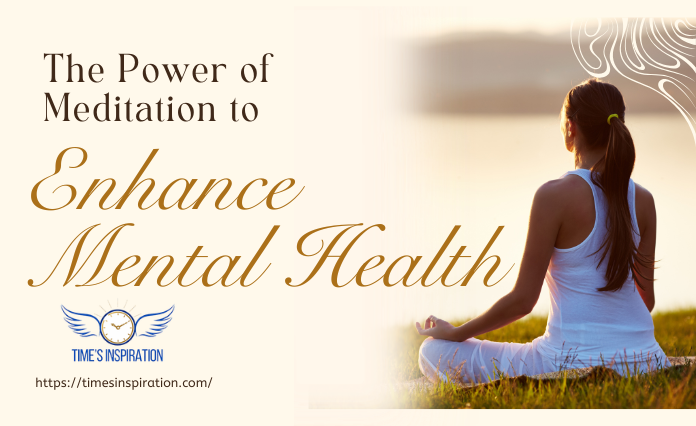
The Power of Meditation to Enhance Mental Health to The time is eleven of the clock at night. At last, the house is silent, yet you can feel your thoughts racing.
You bring up the challenging discussion from earlier. Your mind races with concerns about the tasks that lie ahead. Everything you have not accomplished, everything you are afraid of, and everything you wish were different weighs on you. I miss the comfort of sleep.
Such an occurrence is common. Tuesday night is little more than that for millions of individuals, including students dealing with test stress, parents balancing difficult schedules, and young professionals who burn out before they have even started.
Problems with enhance mental health are among the most common and poorly understood aspects of contemporary living. Feelings of constant stress, emotional tiredness, lack of concentration, and anxiety deprive us of much more than just peace of mind. Every aspect of our lives, including our jobs, families, relationships, and self-esteem, is impacted by them.
This is in contrast to an old, free, and evidence-based approach that is revolutionizing people’s lives all around the globe. It calls for minimal time, no particular skills, and no specific equipment.
Meditation is that practice. And if you have ever written it off as “not for people like me,” then you are the target audience for this piece.
This is the most preoccupied age that humanity has ever experienced.
Our neurological systems are taking in more stress than they were ever meant to—notifications, deadlines, social comparison, economic pressure, and global uncertainty. The end consequence is a worldwide epidemic of mental illness that affects people of all ages, backgrounds, and socioeconomic statuses.
Every year, the world’s economy loses more than a trillion dollars due to sadness and anxiety, according to the World Health Organization. However, there is an incalculable human cost in terms of relationships damaged, potential unfulfilled, and silent suffering.
The mind does not retain stress. It is a part of the body. Elevated cortisol levels, disturbed sleep, compromised immunity, impaired memory, and inflammation are all symptoms of chronic anxiety. An unhealthy body is the result of a restless mind.
The foundation of mental wellness is addressed by meditation. Not by denying or numbing out unpleasant emotions, but by learning to live with them instead. The ability to simply watch without responding changes everything.
Many people have looked to meditation as a spiritual practice for a long time. What meditators have long suspected—that it alters brain structure—is now supported by scientific evidence.
The prefrontal cortex, which is involved in attention, decision-making, and emotional control, thickens with frequent meditation, according to research from Harvard Medical School. Simultaneously, it lessens the size and responsiveness of the amygdala, which is responsible for processing stress and fear in the brain.
Put simply, one’s thinking brain becomes stronger and one’s panic brain becomes calmer through meditation.
Participants in a seminal study conducted at Massachusetts General Hospital shown statistically significant improvements in anxiety, sadness, and psychological distress after completing an eight-week mindfulness program. Those individuals had not spent years in meditation. They began with modest, regular practice; they were just regular folks. Peruse the Harvard research on the neural bases of mindfulness.
Training one’s attention is the key to practicing mindfulness, the guiding concept of most forms of meditation. We can lessen our tendency to ruminate (think about the past) and catastrophize (be afraid of the future) by bringing our attention back to the here and now on a regular basis. Most cases of anxiety and sadness stem from these two thought patterns.
One can learn to control their thoughts. If all of modern psychology has any encouraging finding, it would be that.
The majority of people who experience and enhance mental health issues do not appear to be struggling.
Each day, they report to their respective workplaces. At family gatherings, they smile. On the internet, they write up good stuff. They may be sleeping it off on the surface, but deep down, they are fatigued. They have a severe lack of self-awareness and emotional connection to others they care about.
Oftentimes, students lack the vocabulary or social support to articulate the weight of performance, identity, and future uncertainty. Parents often put themselves last on to-do lists because they are always juggling the demands of providing for their children, protecting them, and being present for them.
There is a horrible notion that everyone else has figured out what young professionals do not, imposter syndrome, and comparison culture.
All of these individuals are strong. We should provide them with tools.
Stress that goes unchecked can have far-reaching effects on relationships as well as the mind. Our loved ones take the brunt of our anger when we are dysregulated. When we ought to be connecting, we pull back. Fear, not wisdom, governs our decision-making. Our loved ones are bearing the weight of a mind that was never instructed in the art of meditation.
Because of this, meditating is not an extravagance. When caring for oneself or others, it is among the most responsible things a person can do.
Sana started having panic episodes around 3 in the morning when she was 19 years old and a second-year university student. Failing frightened her. Worried she will let her parents down. I dread what the future holds.
She learned about a five-minute breathing exercise on YouTube from a friend. She believed it was too easy to be effective. Nonetheless, she gave it a go first thing in the morning for two weeks, and to her surprise, her panic attacks became less frequent. Her sleep had improved. After months of feeling helpless, she finally felt like she could direct her thoughts.
In her last year, Sana established a daily meditation practice of twenty minutes. She achieved the highest possible class rank upon graduation. Even better, she left with the knowledge to maintain her own mental health throughout her life.
James’ doctor warned him that his blood pressure was dangerously high when he was 41 years old, a father of three, and a mid-level manager. Uncontrolled stress, not a lack of physical activity or healthy eating, was to blame.
A mindfulness-based stress reduction program, in addition to dietary and exercise adjustments, was prescribed by his doctor. Though he was urgent, James remained skeptical. His blood pressure plummeted in just eight weeks. He was getting a deeper night’s sleep. Instead of drifting off to sleep at work, he was fully present with his kids when he got home from work.
“I did not realise how loud my mind was,” he recounts, “until I learned how to make it quiet.”

Consistent daily practice, rather than occasional indulgence, yields optimal results from meditation. The morning is perfect because it gives you time to relax and recharge before the chaos of the day begins. For individuals who want to relax before going to bed, the evening is the perfect time.
Choose one moment and hold on to it. Take it easy for five minutes at first.
You can get by without a fancy space or pricey couch. You can use a chair, a nook in your bedroom, or even a garden as your workspace. The most important thing is that you are able to relax and unwind for a little while.
As time goes on, your body will begin to link this area with feelings of peace. The journey there itself becomes an integral aspect of the routine.
Get in a deep sleep. Breathe in deeply through your nose for four counts and out through your mouth for six. Repeat this process three times. After that, just let your breathing return to how it normally occurs.
Just keep an eye on your breath. Pay attention to the feeling of air going in and out. Nothing needs to be changed; all you have to do is pay attention.
Your thoughts will stray. It is the practice, not the failure, that matters. Redirecting your attention to the breath whenever you become aware that your thoughts have wandered is a form of brain training.
Picture it like push-ups for your mind. Loss is the burden of the traveler. Building strength is the returning.
Start implementing a modest body scan once breath awareness becomes natural. Gradually bring your awareness to each part of your body, beginning at the crown of your head and working your way down to your toes, without attaching any value judgments to what you feel.
For individuals who physically hold stress in their shoulders, chest, or stomach, this technique can be very potent as it reconnects the mind and body.
Praying silently, “May I be well. May I be at peace. May I be free from suffering.” This compassionate expression can be addressed towards yourself and others, and should be repeated several times before end of practice.
This loving-kindness practice has several benefits, including less self-criticism, more good emotions, and more resilience, according to research. It subtly changes lives for people who have low self-esteem.
Take a deep breath in before you open your eyes, and then tell yourself something simple like, “Today, I will respond rather than react.” Or, “Today, I will be gentle with myself.”
Here is where the power of your practice truly shines—in your everyday life.
Consistent meditation has benefits that extend well beyond the time spent sitting quietly.
Concentration and mental strength – Consistent meditators claim to have enhanced focus, memory, and decision-making abilities. Clear thinking might arise when the mental chatter subsides.
Having consistent feelings – Instead of eradicating unpleasant feelings, meditation alters our perspective on them. Those who practice regularly learn to monitor their emotions without letting them rule them, so they can better handle situations when they are angry or anxious.
Improved rest – A perk that everyone seems to agree on. Many individuals find that meditation helps them sleep by calming their nervous system and reducing the amount of mental chatter. When you get a good night’s rest, your attitude, immunity, productivity, and patience all improve.
Improved connections- Quietness makes one a more compassionate person. Your presence and lack of reaction make you a more secure person to be around. This is how families feel. Coworkers experience this. Especially kids experience this.
Depression and anxiety levels dropped – A number of scientific studies have shown that mindfulness-based techniques can alleviate anxiety and depression symptoms—in some cases even more so than medication—while causing no negative side effects.
Integrity and leadership – A great leader is someone who can maintain composure under pressure, who can listen attentively, and who can answer deliberately rather than emotionally. Meditation strengthens all three.
First myth: “I can not meditate — my mind is too busy.” This is the most popular excuse people give for not beginning meditation, and it stems from a misconception. One of the main points of meditation is not to quiet the mind. The key is to watch them without letting yourself be controlled by them. You can still meditate even if your mind is racing. That is precisely why it is necesary.
Myth 2: “Meditation is religious or spiritual — it is not for me.” The evidence-based kind of meditation that is used in hospitals, schools, and corporate wellness programs is nonreligious, although it does have roots in contemplative traditions. Sitting silently and focusing on your breath can help you regardless of your beliefs.
Thirdly, I refuse to believe that “I do not have time to meditate.” All it takes is five minutes to start. There are observable changes in brain structure and stress response with even short daily meditation, according to the research. Whether or if you have five minutes is not the question. You have to decide if you think five minutes is worth it to enhance mental health.
Fourthly, contrary to what the data suggests, “It only works for calm, spiritual people.” No such thing. Children with Attention Deficit/Hyperactivity Disorder (ADHD), CEOs dealing with high-pressure situations, and others suffering from clinical depression have all benefited from meditation. The fact that it is a skill means that everyone can pick it up and get better at it, which is why it works.
As much as she enjoyed her job, 34-year-old Elena felt like she was drowning in her workload in Lisbon.
She had stopped exercising after four years on a high-pressure ward, during which she had compassion fatigue, persistent migraines, and a feeling she compared to “a numbness that scared me more than the sadness ever did.” What used to heal her no longer brought her delight.
An eight-week Mindfulness-Based Stress Reduction (MBSR) program was recommended to her by a coworker. At first, Elena resisted; she did not think she deserved to relax and thought it was a waste of time to do nothing when there was so much to accomplish.
It was awkward for the first two weeks. She continued, nevertheless.
She had not slept through the night in two years until she discovered it in week five. Colleagues observed that she appeared lighter by week eight. After three months of consistent practice, Elena was able to get back into jogging, spend more time with her family, and most importantly, remember why she chose to become a nurse.
“The meditation did not change my circumstances,” she asserts. “It changed me. And that changed everything.” The University of Massachusetts MBSR Programme has further information on MBSR and the clinical proof it has.
Do not be afraid to start small. Every second matters. In the beginning, consistency is more important than depth. Practicing for two minutes each day is better than never practicing at all.
Secure it to a preexisting routine. Do some meditation first thing in the morning, either after you brush your teeth or before you have your coffee. A tried-and-true method for making a new habit automatic is to link it to an existing one.
Start by utilizing guided meditation applications. A lot of beginner-friendly apps, like Insight Timer, provide thousands of free guided sessions. A supportive mentor can make a world of difference for people who are shy or do not know where to begin.

Write down your meditations in a brief notebook. Afterwards every session, jot down a single statement expressing your emotions. This straightforward log will eventually become compelling proof of your personal growth—and inspiration on the tough days.
Forgive yourself if you fail to complete a task on a given day. Skipping a single session does not constitute a failure. Allowing a single miss to snowball into a string of misses is the sole genuine challenge. Come back without critiquing yourself. Start over. In its purest form, that is the practice.
Make time every day to practice micro-meditation. Prior to engaging in a challenging discussion, take three deep, deliberate breaths. Just wait a minute before you check your email. Intermission is a deliberate pause. A life that is more peaceful and clear is the result of these little acts of presence.
No one is counting on you to be perfect. It requires you to be in the here and now, rooted, and open to development.
The solution to every problem does not lie in meditation. But it sets the internal stage for dealing with adversity in a thoughtful, compassionate, and orderly manner rather than in a reactive one.
You will be doing something subtly revolutionary if you start a daily practice of five minutes right now, just tonight. Your emotional well-being is in your hands. You are opting to be your best self for those who truly deserve it, rather than the worn-out, overwhelmed version that stress often leaves behind.
A healthy lifestyle was instilled in you by your parents. Holistic individuals are essential to your community. You are an inspiration to the youth of today because you have shown them that calmness is achievable even in the midst of chaos.
Just take a deep breath. Just one exercise. A subtle upheaval.
Our belief at timesinspiration.com is that a strong mind makes a life worth living, and not only to you, but to everyone you meet.
Start right now. Here we go. The tranquility you seek has been patiently waiting for you the whole time.